The AIS of Pas-de-Calais: a web application serving modern archaeology

Pierre Laulhe
For over 10 years, the Pas-de-Calais Department has been developing its Archaeological Information System (AIS). In 2024, a new version of the application was released, designed to support the complexity of the archaeology profession while anticipating national standards. A look back at an emblematic project at the intersection of technology, science, and design.
A robust data model ahead of its time
One of the pillars of this application is its data model, structured around 78 relational tables. Recently, alignment work with the Ministry of Culture's national reference project has achieved a correspondence of more than 91%. The remaining 9% concerns new fields, easily integrated into the existing database.It embodies a rigorous approach to data, designed to guarantee the consistency, traceability and scalability of the information collected.
Despite its technical complexity, the AIS was designed so that this structural wealth remains totally transparent to users. Each business function benefits from a suitable interface, which guides the user without exposing them to the underlying structure.
An interface designed to fit a diversity of uses
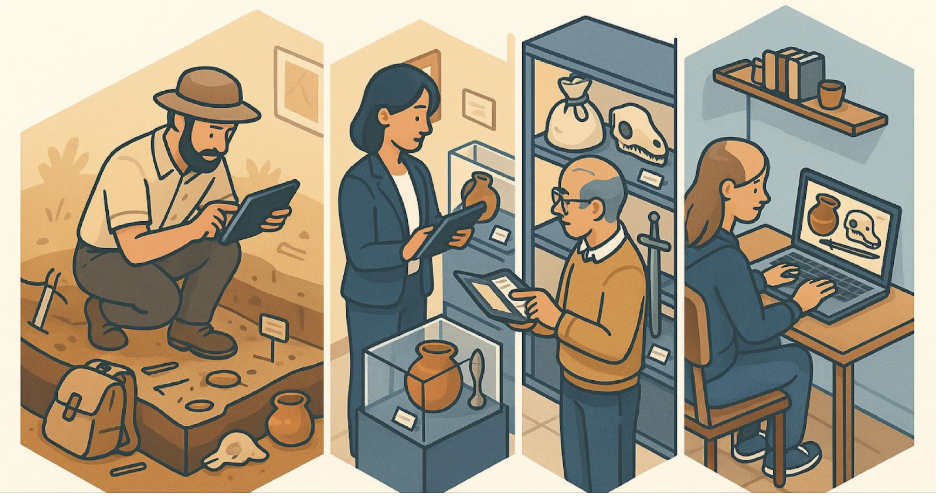
Designing an interface capable of meeting the needs of all stakeholders in an archaeological operation – from field agents to heritage development agents – represented a major challenge.
Thanks to the work of UX/UI designer Lucile Collignon, the application now boasts a clear, consistent, and intuitive interface. After extensive specification and usage mapping, a dynamic prototype was used to test, refine, and validate ergonomics adapted to the diversity of uses, while ensuring a seamless experience, even with large volumes of data.
Proven performance on significant volumes
The AIS is not just a beautiful interface. It is also a field-proven application capable of handling significant volumes of data:
- 1,347 archaeological projects referenced,
- 149,797 registration units (EU),
- 278,858 documented movable objects.
A free, reliable and reproducible solution
The Pas-de-Calais Department's AIS is now an open-source solution, documented and deployable by other local authorities. This openness guarantees code transparency, the pooling of development efforts, and the opportunity to build synergies on a national scale.
This project embodies a dual ambition: to advance digital archaeology tools while making them more accessible, more standardized, and more adapted to field realities. We warmly thank the Pas-de-Calais Department for its trust, as well as the entire project team for this wonderful human and technical adventure.
Get in touch with Camptocamp
Author
Career
Interested in working in an inspiring environment and joining our motivated and multicultural teams?