GeoServer hosted on Red Hat
OpenShift
The right approach to manage your map services?
OpenShift is already widely known as a powerful enterprise-ready orchestration platform for the deployment and management of containerized applications and services.
The use cases of OpenShift are manyfold and in the geospatial world exist numerous applications that have been successfully run using OpenShift. Here we want to showcase how Openshift can handle the containerization of GeoServer, an open source software for generating and publishing map services.


A great advantage of the deployment with OpenShift is that the configuration of a GeoServer instance is safely stored between restarts enabling a smarter and more efficient way for managing GeoServer in an operational context.
Besides the hosting of a classic GeoServer application via OpenShift, we currently work with the new technology Cloud Native GeoServer (also referred to as GeoServer-Cloud) which builds on top of standard GeoServer but comes with powerful capabilities to increase the hidden potential of GeoServer in high-available cloud infrastructures.
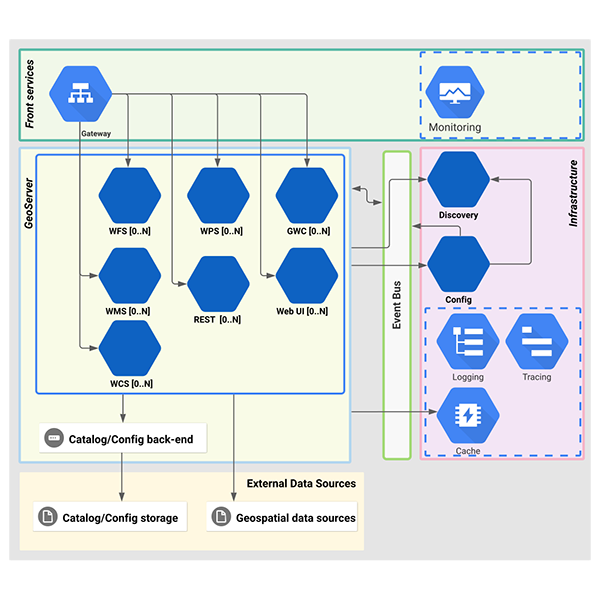
GeoServer-Cloud provisions the core functionalities of GeoServer in a dynamic high-load environment. As such functionalities and services can be configured, dimensioned and deployed individually. Map Services and components of the API (e.g. the UI) are now accessible via a container based architecture of micro services.
With GeoServer-Cloud, long gone are the days of setting up ad-hoc clustering strategies, installing unsupported extensions, manually editing several configuration files in the “data directory”, discriminating between “master” and “slave” instances, or creating scripts to restart cluster nodes upon configuration changes.
GeoServer-Cloud just works on modern public, private, or hybrid cloud infrastructures, provides a curated list of extensions and allows to configure exactly which ones to enable.
GeoServer-Cloud microservices are loosely coupled and prepared to work on dynamic cloud environments, where instances may be reclaimed or killed by the container orchestrator. Configuration changes are broadcasted to all instances, which react accordingly without wait periods or configuration reloads.
GeoServer-Cloud being designed to take advantage of the speed and efficiency of the cloud results in a number of benefits.
Cost-effectiveness:
Computing and storage resources can be scaled out as needed, based on each service’s performance characteristics and resource needs. This eliminates the overprovisioning of hardware that usually comes with the monolithic GeoServer.Independent scalability:
Each microservice is logically isolated. If one microservice is changed to scale, the others will not be affected. Moreover, scaling down to zero instances of unused microservices is as important as the ability to scale out to satisfy demand or high availability requirements.Reliability:
if a failure occurs in one microservice, there's no effect on adjacent services.Ease of management:
Use of automation to deploy application features is encouraged and facilitated by the centralized and externalized application configuration.
What's in favor of Red Hat OpenShift?

Red Hat OpenShift lets you take advantage of standard Kubernetes technology, while benefiting from additional first-class features, such as:
a fully automated installer compatible with Amazon AWS, Microsoft Azure, Google Cloud, VMware vSphere, Bare Metal, OpenStack and IBM Z
advanced RBAC with fine-tuned permission control
CI/CD integration with Jenkins, Tekton and optionally GitLab
automatic project builds with S2I
- quay.io container registry with optional security features, e.g. automatic scans of containers for known vulnerabilities


Get in contact with us!
Career
Interested in working in an inspiring environment and joining our motivated and multicultural teams?


